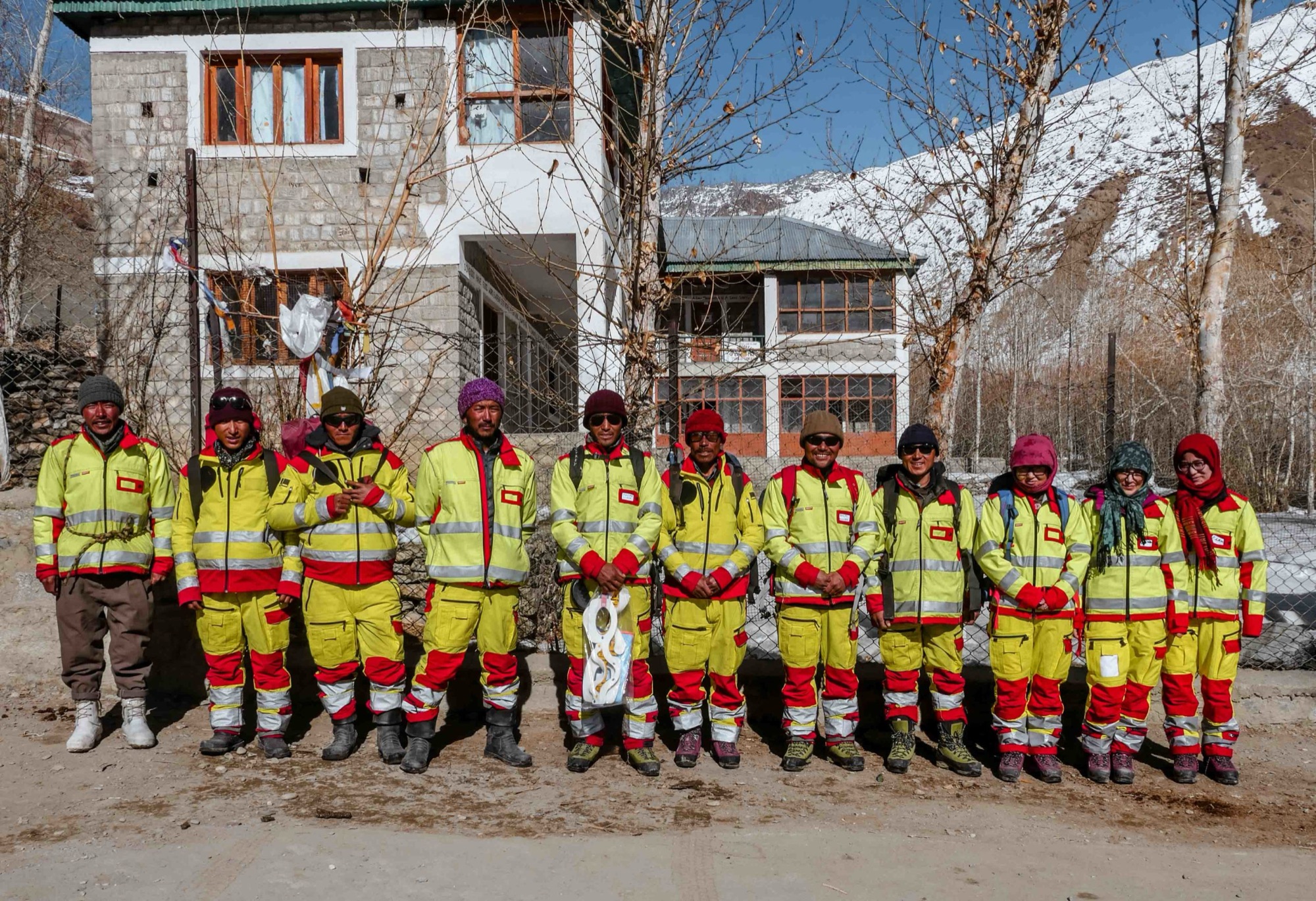
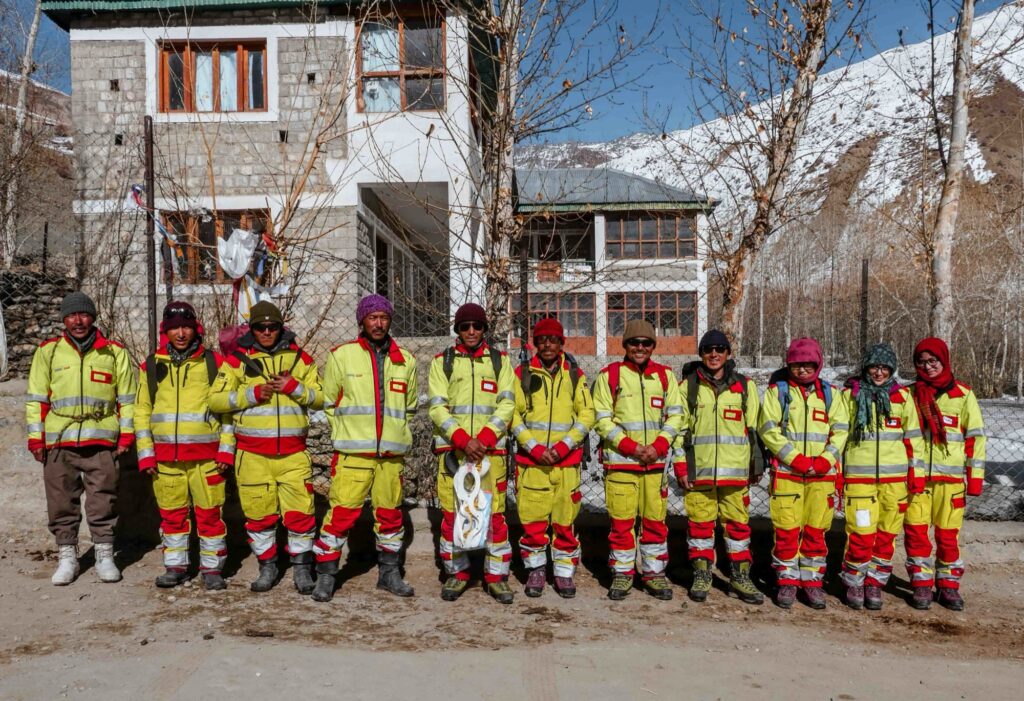
Our mobile rescue team enables home based care and safe patient transport.
After a full day of discussion about the health problems in winter at the 2nd Zanskar Health Conference came the idea to build the Zanskar Rescue Team in the fall of 2016. The objective was to help the villagers of Tungri to set up a land-based rescue team to enable safe transport of patients to the hospital of Padum (the only one in Zanskar), especially when all roads are blocked by snow. Eight strong and motivated Zanskari youths expressed their motivation to become the first rescue team in Zanskar.
Why a rescue team
For six to seven months a year the valley is cut off by road and temperatures drop to -40°C. Reaching a patient’s home is long and difficult, and both allopathic and traditional practitioners lacked training and equipment for emergencies. Frequent health problems in winter include worsening joint pain and obstructive lung disease, dental problems, oedema, and complications of pregnancy and delivery.
Allopathic staff often leave for warmer regions in winter, so people rely even more on the amchi of their village. Without reliable communication it was hard to call for help, and with the roads closed, a helicopter transfer to a larger hospital can take three days for administrative reasons.
Objectives of the project
- Train all team members in winter mountaineering and rescue techniques: snowshoeing and basic mountaineering, avalanche risk knowledge and rescue
- Teach basic skills in rescue medicine
- Teach safe patient transport with a patient rescue sled
- Ensure a free rescue service for the population
- Ensure a payroll for the rescue team staff
- Ensure annual continuous training for the rescue team, and peer-training in the long term
- Enable a reliable communication system in winter
History
January and February 2018
Launch of the project and first training
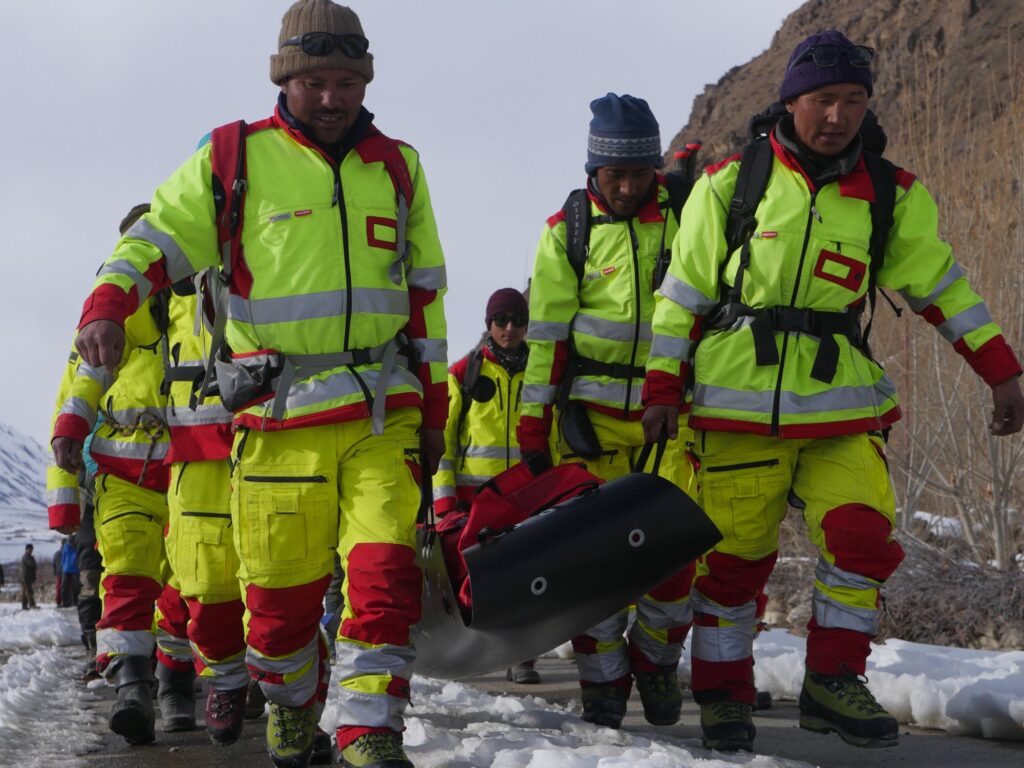
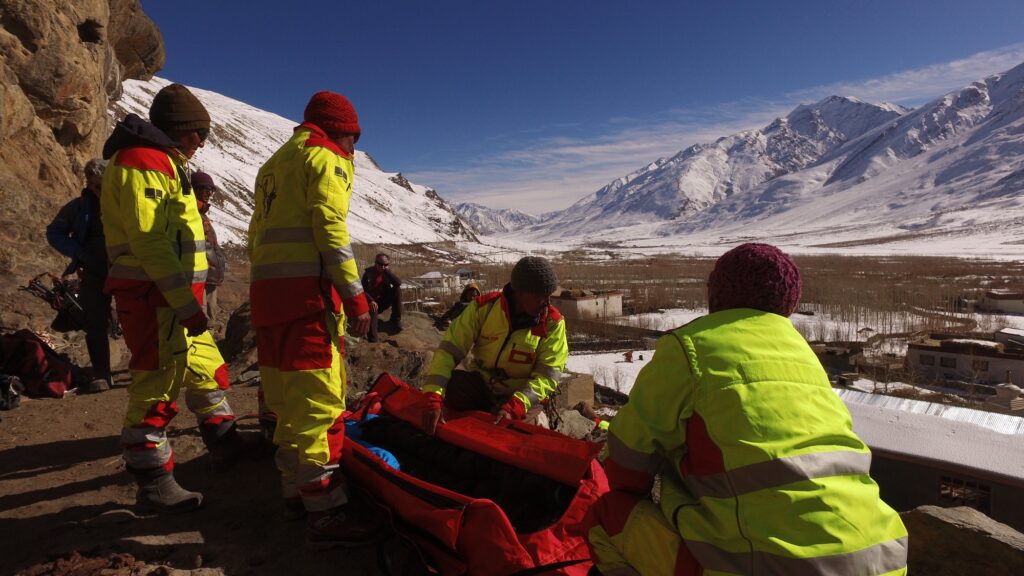
An international team of experts spent 10 days in Tungri. The technical team trained with mountain guide Steve Long in safety, rope technique, snowshoeing, navigation, avalanche awareness and patient transport on the stretcher, while the medical team had hands-on classes every day in the dispensary. The training ended with two days of realistic scenarios for the whole team: an acute abdominal problem, a pregnant woman who was bleeding, and a trauma case in exposed terrain.
Members of the Zanskar Rescue Team at launch
4 technical rescuers, all from Tungri village:
- Padma Sonam, driver
- Thuckjay Angchuk, carpenter
- Thuckjay Tahan, farmer
- Stanzin Phunchok, driver
The two villages of Ralakung lie two days’ walk from the valley floor, separated by a pass. Until then, the only way to call for help from one village to the other was to throw soil on top of the pass and hope someone would see it. Four men from Ralakung joined the training; we gave them mountaineering clothes, snowshoes and two walkie-talkies so the villages can now talk to each other across the pass.
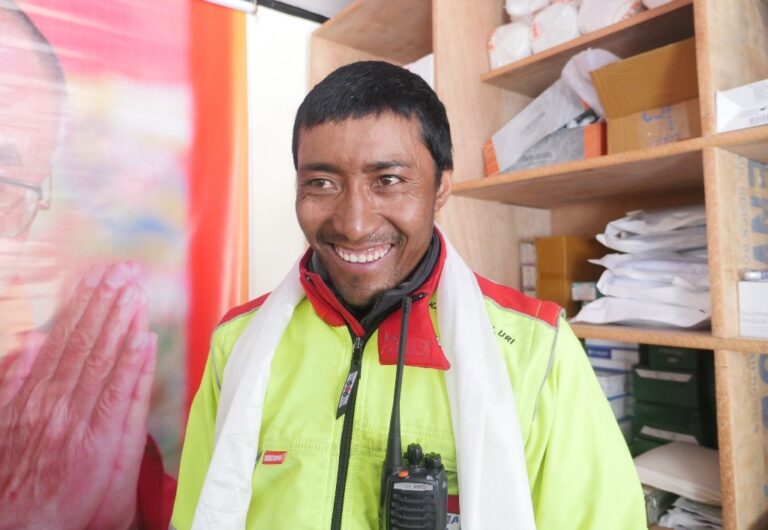
4 medical rescuers:
- Stanzin Dolma, nursing student, Tungri
- Pedma Lamo, nurse, Tungri
- Stanzin Naskit, nurse, Tungri
- Tashi Dorjay, amchi (traditional medicine), Rantakshar, next to Tungri
Communication
The mobile network is unreliable, there is no good internet connection and satellite phones are not allowed. After some effort the team obtained a semi-official permit to use walkie-talkies. The technical team visited every village of the Stod side valley to present the project and hand a walkie-talkie to a trusted person. Every day they run a chain call from village to village to check that the connection works.
Equipment
- High-quality winter clothing
- Snowshoes and avalanche rescue material
- Essential medicines and basic medical supplies
- Rescue equipment (patient stretcher, casualty bag)
- Basic mountaineering equipment (rope, harness, crampons, ice axe)
- Walkie-talkies (satellite phones are strictly prohibited in the region)
Training experts
- Steve Long, mountain guide, Chairman, UIAA Training Panel, United Kingdom
- Elisabeth Marth, gynaecologist and obstetrician, Innsbruck, Austria
- Christophe Huehn, general and emergency physician, Geneva, Switzerland
- Jean-Luc Magnenat, internal medicine and pneumology, Geneva, Switzerland
- Eloïse Magnenat, assistant doctor in internal medicine, Biel
- Amalie Frandsen, assistant doctor in internal medicine, Biel
Organizing team
- Rebecca Hertzog, assistant doctor in internal medicine, Altdorf
- Yeshi Dorjay, trekking guide, Zanskar
These professionals trained the Zanskari team on a voluntary basis, in their spare time.
August 2018
Second technical training
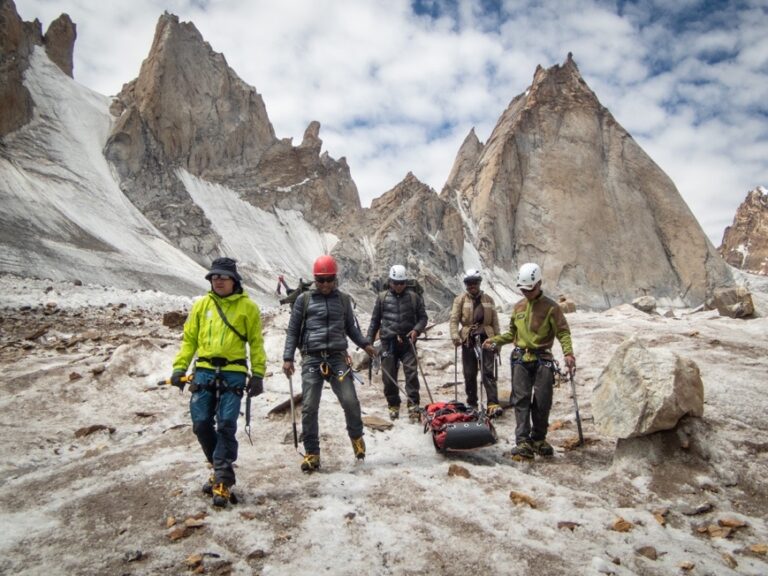
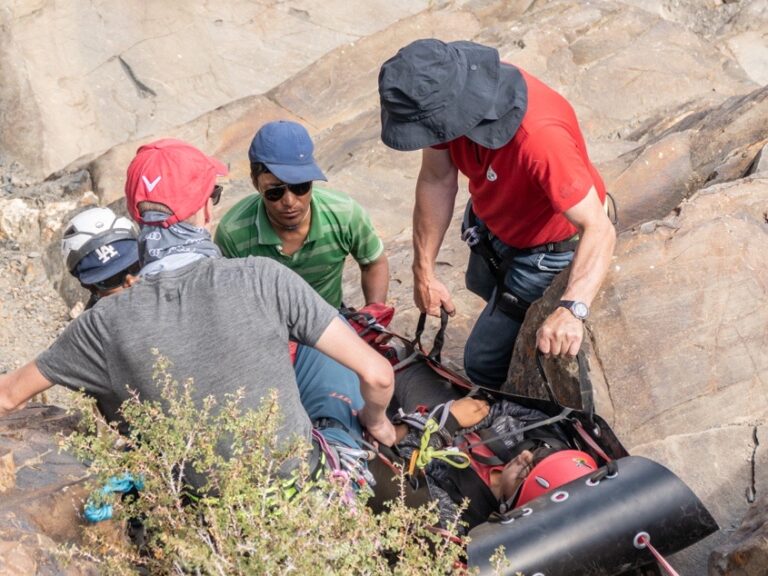
Objectives: revise the skills learned during the first session and add new skills after checking what the team had retained.
The training fell during the harvest, so the Ralakung team could not join. The Tungri team now trains every month and planned to pass the new skills on to the Ralakung team during the winter.
Participants: the 4 technical rescuers of the Tungri team, Padma Sonam, Thuckjay Angchuk, Thuckjay Tahan and Stanzin Phunchok. New equipment: same as in January 2018.
Training experts
- Steve Long, mountain guide, Chairman, UIAA Training Panel, United Kingdom
- Manfred Meusburger, Lech Rescue Team Leader, Austria
- Raphael Meier, Lech Rescue Team, Austria
- Marcel Ziegler, Lech Rescue Team, Austria
Conclusion
- The experts could see that the local rescue team had practised the skills regularly since the last teaching.
- They trained stretcher handling in moderately difficult terrain, scenarios requiring rope work for safety, and additional winter skills on the glacier at Rantik Tokpo base camp above Tungri village.
- The trainers were impressed by the commitment of the team and recommended involving a junior team of trainees, to give physical assistance in emergencies and prepare the next generation of rescuers.
- Perspective: two young men of Tungri have joined as trainees.
2018
First interventions
- The Ralakung team had one summer rescue. The patient had to be transported on a horse; they brought him to Padum hospital in time and he survived.
- The Tungri team brought a patient with acute urinary retention by car to the hospital, because the nurses and amchi could not help him sufficiently in the dispensary.
- A critically ill seasonal worker from Nepal was taken to Padum hospital, then transferred to a larger hospital.
- The team rescued an elderly sick person and received a certificate of appreciation from the Block Medical Officer of Zanskar.
- In winter the Ralakung team cared for a woman with complications in childbirth. Heavy snow and the long distance made a sled rescue too difficult, so they organized a helicopter.
- During heavy snowfall the team opened footpaths with snowshoes to keep houses and villages connected.
- The amchi and nurses treat 3 to 10 patients a day in the medical aid center in Tungri.
- The rescue team collected and processed medicinal plants with the amchi, and two men from Tungri travelled to Dharamsala to buy additional amchi medicine, enough for the whole winter. This shows the commitment of the community to their local medical system and to the project.
June 2019
Third technical training
For the first time the training took place in Leh rather than in Zanskar, as part of a UIAA teaching session for trekking guides from Ladakh.
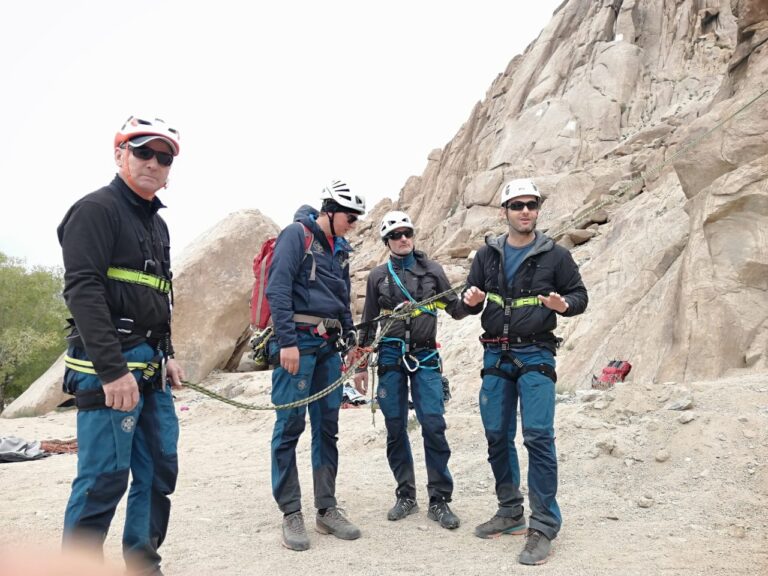
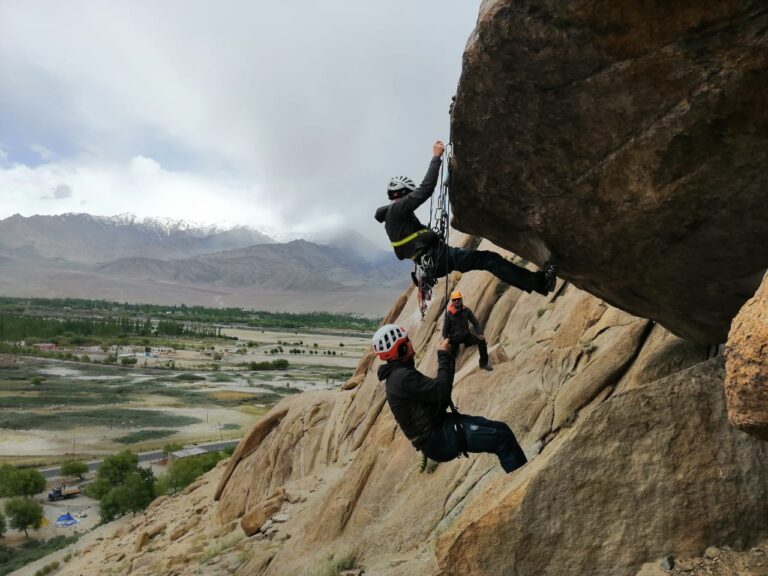
Participants: the Tungri team, the 4 members of the Ralakung team, and Stanzin Tsephel, one of the two first female rescuers in Zanskar. New equipment: a second rescue stretcher, a new rope and rescue harnesses.
Training experts
- Manfred Meusburger, Lech Rescue Team Leader, Austria
- Markus Amann, Deputy Leader of Helicopter Rescue, Bergrettung Vorarlberg, Austria
- Franz Josef Schmutzer, Operation Leader, Bergrettung Lech, Austria
- Daniel Walch, rescuer, Bergrettung Lech, Austria
- Steve Long, mountain guide, Chairman, UIAA Training Panel, United Kingdom
Conclusion
- The training was a real success and took place at the same time as the training of the mountain rescuers of Leh, who also attended a mountain leadership course.
- The teams worked very independently and got much further than expected.
- The training went from basics like knots and preparing a patient for transport to advanced rescue techniques, with basic snow knowledge and avalanche training.
- Next steps: an inventory of team and personal equipment per location (Tungri, Ralakung), one team member responsible for equipment, a summer stretcher with a wheel and one for snow.
2019
Arrival of the ambulance
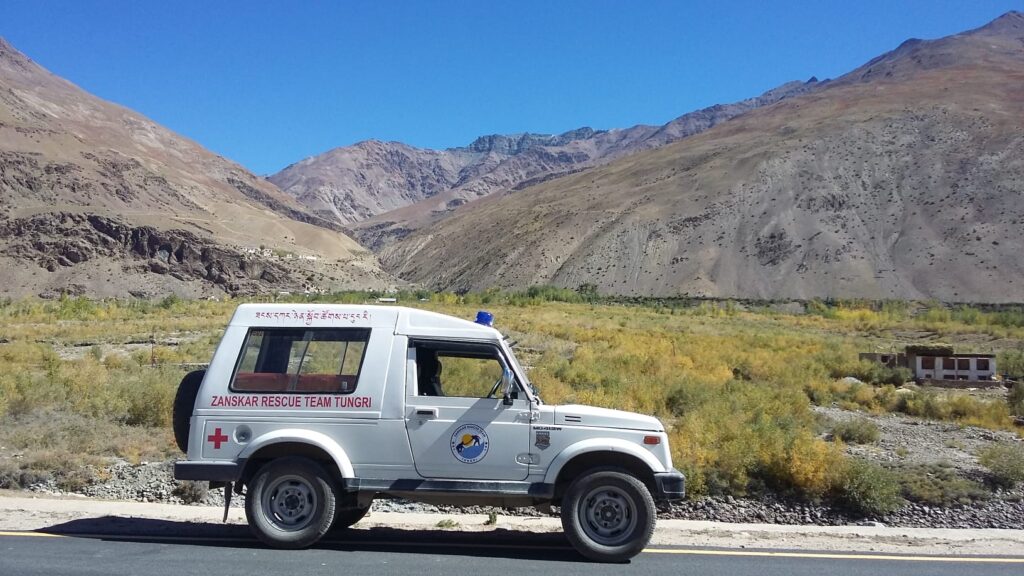
Thanks to a generous sponsor our rescue team could purchase a jeep customized as an ambulance, allowing much faster transport, including of patients lying down. The jeep is particularly robust and can even drive in snow. Beyond rescues, the ambulance has been used to buy medicine, helped build the ice stupa, enabled home visits by the amchi and nurses, and supported awareness campaigns on health issues. We thank AVICEN SA for their generous sponsoring of the ambulance.
Interventions in 2019
- The team transported a woman with placenta retention by sled to Padum; she was then airlifted by helicopter to Leh. Mother and baby are fine. After this rescue in heavy snow, our technical experts decided to provide a new sled that slides better in deep snow over longer distances (Akja sled by Tyromont).
- A man who fell from his roof while clearing snow was transferred to Padum hospital.
- An elderly, ill monk from Karsha monastery was taken to hospital in Padum.
- A woman who slipped in the snow and injured her knee got first care from the dispensary nurses and was referred to Padum hospital.
- Even in the remote village of Raru (Lungnak region), the team picked up a critically ill patient after a huge effort clearing their way through the snow.
- A woman in labour was taken to Padum hospital.
2020 and 2021
Training continues locally
In March 2020 the team ran an awareness campaign in the villages about the symptoms of COVID-19 and how to prevent it.
Because of the coronavirus pandemic, travel was not possible and no teaching session could take place in Ladakh. Our local team nevertheless kept training the skills they had learned and stayed on call for emergencies. The next teaching session is planned to move to peer-training, so that the project becomes self-sustaining.
All projects | Next: Medical aid center