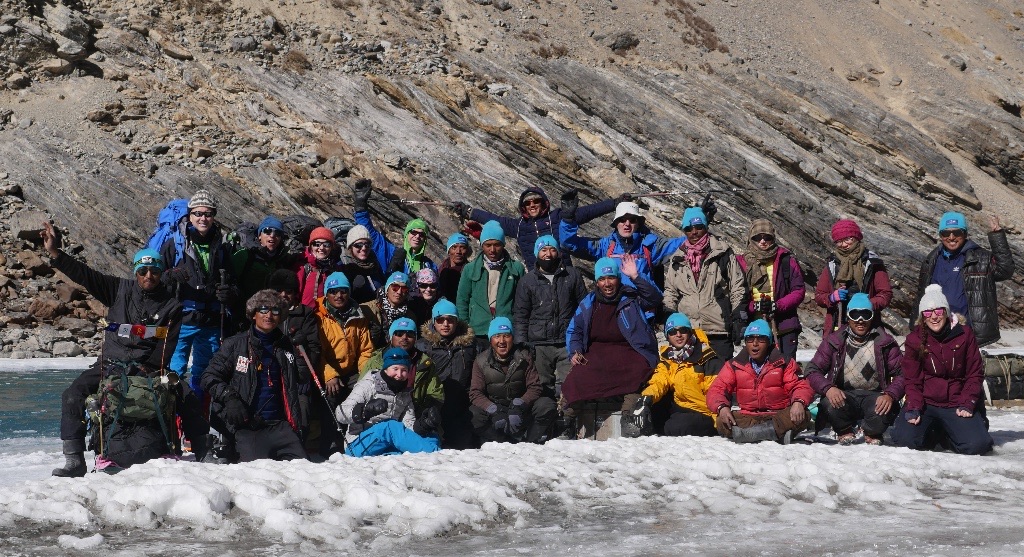
On 20 January an interdisciplinary and international team of experts arrived in Leh, the capital of Ladakh: our technical instructor Steve Long, mountain guide and UIAA instructor, and the medical team of general physicians and one gynaecologist, Elisabeth Marth, Christophe Huehn, Jean-Luc Magnenat, Eloïse Magnenat and Amalie Frandsen. With them was filmmaker Laetitia Clément, who is working on a documentary about the project. Unfortunately two members of the team had to return from Delhi after a sudden loss in their close family.
We reached Zanskar on 24 January after trekking on and along the frozen river called the Chadar, a very impressive way, full of beauty and also of danger, as you will read later. 17 men from Tungri accompanied us. They all came voluntarily because the project means so much to their village and valley. Their strength and motivation were as impressive as the mountains around us, and we soon became friends with a strong team spirit.
Ten days of teaching
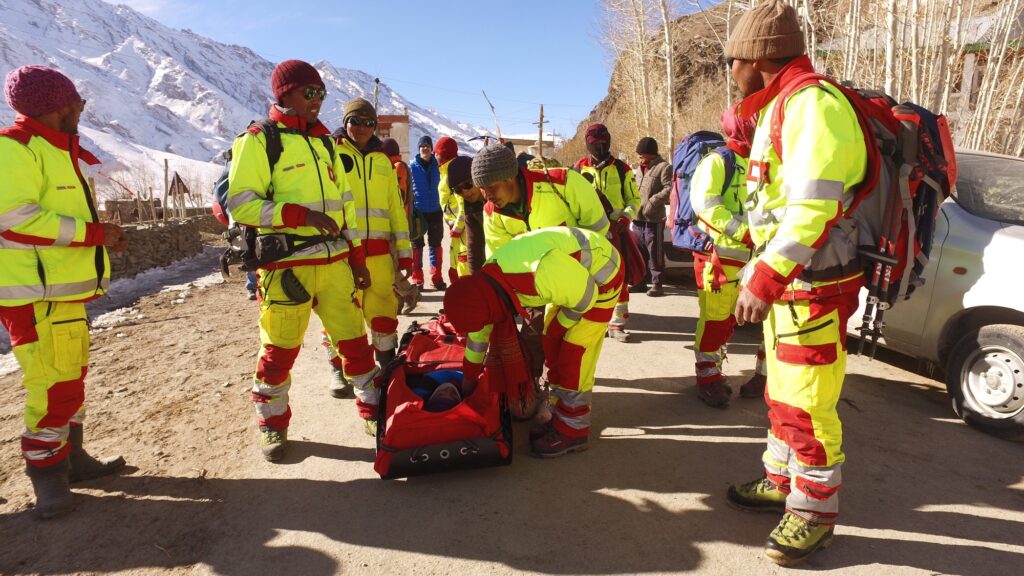
In Tungri, the village where the rescue team has its base, the whole village gave us a very warm welcome. Classes started on 25 January. After a day of teaching for the whole team on general medical and technical topics, safety, vital signs and the new equipment, the medical and technical teams were taught separately. The four technical rescuers from Tungri trained with Steve Long in safety, rope technique, snowshoeing and patient transport on the stretcher.
The medical team, three nurses and the amchi, had hands-on classes every day in the village dispensary: traumatology, abdominal diseases, chest problems, delivery, gynaecology, and smaller topics like ENT, eyes, and altitude and cold related problems. The exchange with the amchi was friendly and open, and we were impressed by his knowledge and by how fast the whole medical team learned. One nurse even abseiled down the overhanging wall above the village, an event for the whole village.
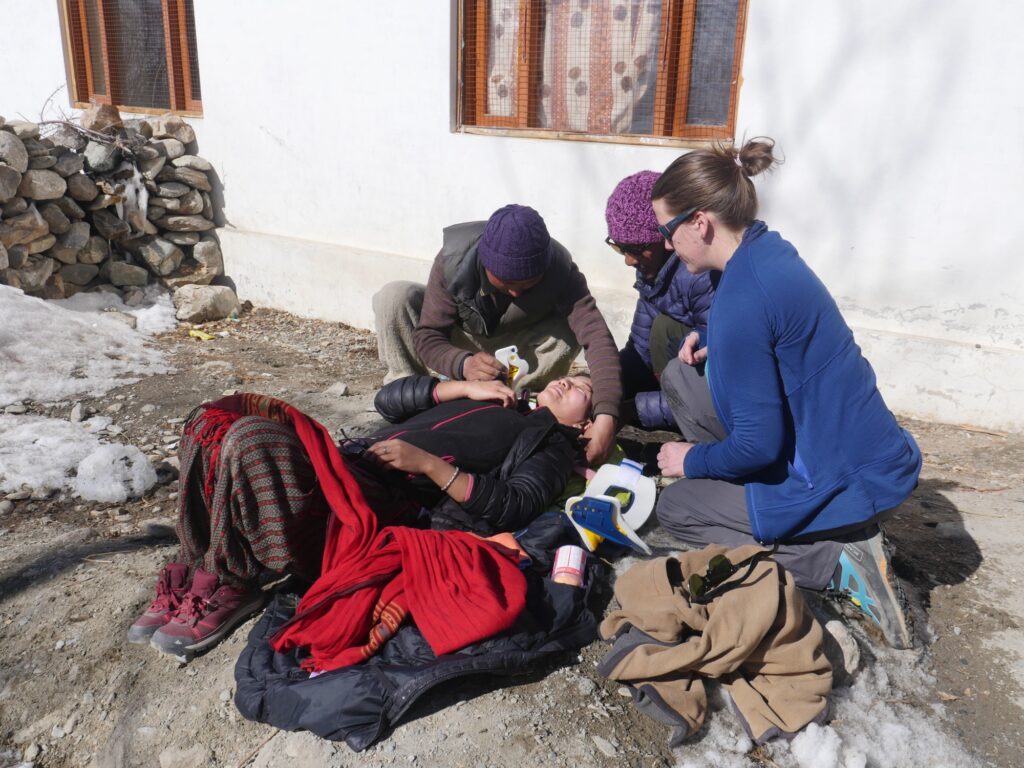
On the last two days we trained realistic scenarios as a whole team, with three mock patients: an acute abdominal problem, a pregnant woman who was bleeding, and a trauma case in exposed terrain. After every scenario we held a feedback round, and the team improved a lot from case to case. Dr Stanzin, Block Medical Officer of Zanskar, came one day to see the project; we are very glad of this friendly and important collaboration. After only 10 days of teaching, the Zanskar Rescue Team went beyond our expectations.
The way back
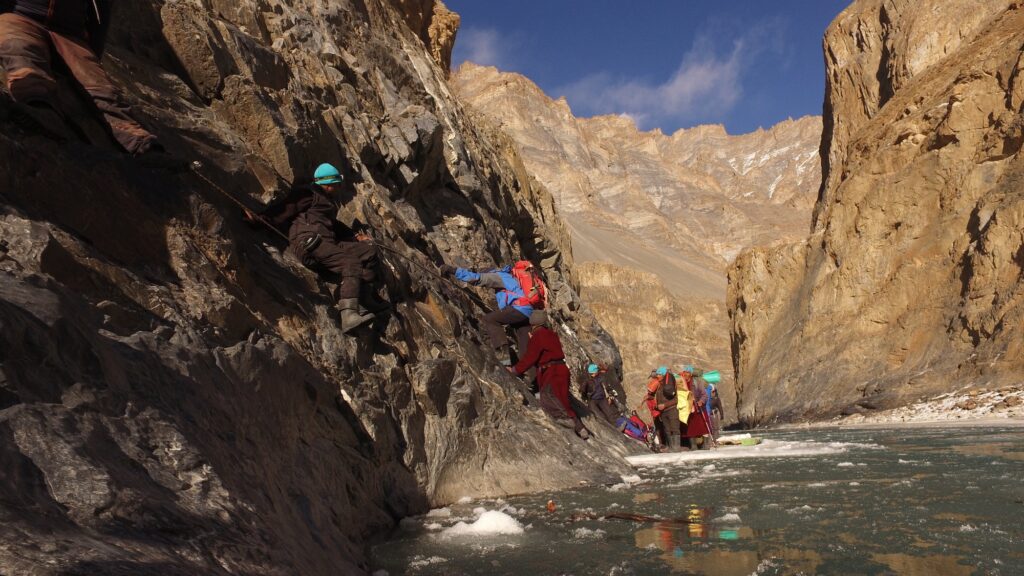
This winter there was very little snow and the temperatures were too mild, which made the ice on the way back much more difficult. Several times we had to climb along the riverside on rotten rock above the water. As a team we managed all these challenging passages, and on the last evening we made a big fire, sang, danced and slept in caves in the rock.
On our last day, 8 February, a tragedy happened. The spot did not look dangerous, and half of the team had already crossed it when a huge block of ice suddenly collapsed and two young Zanskari women fell into the river. The water was wild and they were carried under a sheet of ice. Dolkar, a student travelling back to school in Leh, was rescued further down the river without serious injury. Dolma, one of our rescue team nurses who was returning to complete her nursing studies in Jammu, was trapped under the ice. Our mountain guide and the Zanskari men brought her out of the water, and we tried to resuscitate her for a long time, but Dolma died that morning. It has been very hard for the whole team, and a great loss for her family, her village and us.
We have thought and talked about this a long time. Nothing could have foreseen or prevented the accident, except not going on the Chadar: there was no sign that the thick sheet of ice was unstable. The exceptionally mild temperatures probably warmed the rock and loosened its connection with the ice. This tragedy put a big question mark over the whole project, but after a team debriefing we concluded that the project is meaningful for the valley, and that it was meaningful for Dolma too, otherwise she would not have committed to it. So we will continue, but we will never again travel to Zanskar on the Chadar.
Also during our stay
We set up the rescue team’s base in the government dispensary and equipped it with medical equipment and essential medicines. Since the teaching, the nurses and the amchi treat five to six patients a day, mostly for joint pain or respiratory problems.
Many villagers came to the dispensary for a check-up or with a health problem while we were teaching. It was a challenge to teach and see patients at the same time, so we saw them together with the nurses whenever possible, for teaching and follow-up. Many thanks to all the dedicated doctors who worked so hard.